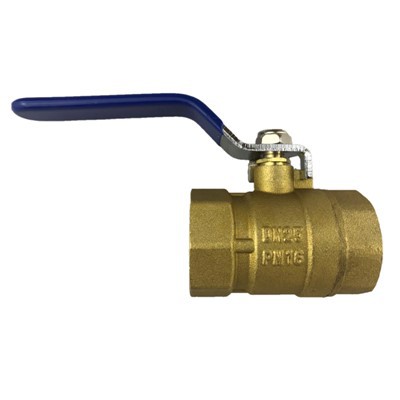
Hey there! As a supplier of Brass Gate Valve, I often get asked about the flow characteristics of these valves. One of the most common questions is whether the flow through a brass gate valve is linear. In this blog post, I'm going to dive into this topic and share my insights.
Let's start by understanding what a brass gate valve is. A brass gate valve is a type of valve that uses a gate or wedge to control the flow of fluid through a pipe. When the gate is fully open, the flow path is unobstructed, allowing fluid to pass through freely. When the gate is closed, it blocks the flow completely. These valves are widely used in various industries due to their durability, reliability, and relatively low cost.
Now, let's talk about linear flow. In a linear flow situation, the flow rate of a fluid is directly proportional to the valve opening. In other words, if you double the valve opening, the flow rate will also double. This is an ideal situation in many applications because it allows for precise control of the flow.
So, is the flow through a brass gate valve linear? Well, the answer is not a simple yes or no. In the initial stages of opening a brass gate valve, the flow rate does increase in a relatively linear fashion. As the gate starts to lift off the seat, the flow area gradually increases, and the flow rate goes up accordingly. However, as the valve approaches full open, the relationship between the valve opening and the flow rate becomes non - linear.
There are a few reasons for this non - linearity. First, at low valve openings, the gate acts as a restriction in the flow path. The fluid has to pass through a narrow gap, and the flow is mainly controlled by the size of this gap. As the gate opens further, the flow area increases more rapidly, but other factors start to come into play.
One of these factors is the flow pattern inside the valve. As the gate moves, it can cause turbulence in the fluid. Turbulence can disrupt the smooth flow of the fluid and affect the relationship between the valve opening and the flow rate. Additionally, the shape of the valve body and the gate itself can also influence the flow characteristics.
Another important factor is the pressure drop across the valve. At low valve openings, the pressure drop is relatively high because the fluid has to overcome a significant restriction. As the valve opens, the pressure drop decreases, but this change in pressure drop also affects the flow rate in a non - linear way.
Let's compare brass gate valves with other types of valves in terms of flow linearity. For example, Stainless Steel Ball Valve has a more linear flow characteristic over a wider range of valve openings. A ball valve uses a spherical ball with a hole in the middle to control the flow. When the ball is rotated, the hole aligns with the flow path, and the flow area changes in a more predictable way.
On the other hand, Brass Y Strainer is not really a valve for flow control but rather a device for filtering out debris from the fluid. It doesn't have a direct relationship with flow linearity like a gate valve or a ball valve.
Stainless Steel Globe Valve also has a non - linear flow characteristic. The design of a globe valve, with a disk that moves up and down against a seat, creates a complex flow path. The flow rate changes non - linearly as the disk is moved.
Brass Ball Valve is similar to the stainless - steel ball valve in terms of flow linearity. It provides a relatively linear flow control over a significant range of valve openings.
In practical applications, the non - linear flow of a brass gate valve can be both an advantage and a disadvantage. In some situations, the non - linearity can be used to our benefit. For example, in systems where a small change in valve opening needs to result in a large change in flow rate at certain points, the non - linear characteristic of the brass gate valve can be useful.


However, in applications where precise and linear flow control is required, such as in some chemical processes or water treatment plants, the non - linearity of the brass gate valve can be a problem. In these cases, other types of valves with more linear flow characteristics might be a better choice.
As a supplier of brass gate valves, I understand the importance of choosing the right valve for the job. If you're not sure whether a brass gate valve is the best option for your application, I'm here to help. I can provide you with detailed information about the flow characteristics of our valves and how they compare to other types of valves.
If you're in the market for a valve, whether it's a brass gate valve, a stainless - steel ball valve, a brass y strainer, a stainless - steel globe valve, or a brass ball valve, I encourage you to reach out to me. We can have a detailed discussion about your specific requirements and I can recommend the best valve for your needs.
In conclusion, while the flow through a brass gate valve is not strictly linear, it has its own unique flow characteristics that can be useful in many applications. Understanding these characteristics is crucial for making the right valve selection.
References:
- Fluid Mechanics textbooks
- Valve manufacturers' technical documents